£1,262.82 tax excl.
Delivery 3 to 5 days
£1,262.82 tax excl.
Delivery 3 to 5 days
£3,540.07 tax excl.
£146.51 tax excl.
Delivery 2 to 4 days
£117.21 tax excl.
Delivery 2 to 3 days
£2,462.84 tax excl.
Delivery 3 to 4 weeks
£10.33 tax excl.
Delivery 2 to 4 days
£1,807.01 tax excl.
Delivery 4 to 6 weeks
£1,807.01 tax excl.
Delivery 4 to 6 weeks
£1,772.13 tax excl.
Delivery 4 to 6 weeks
£1,213.98 tax excl.
Delivery 3 to 4 weeks
£2.51 tax excl.
Delivery 2 to 4 days
£600.71 tax excl.
Delivery 2 to 4 days
£279.77 tax excl.
Delivery 2 to 4 days
£1,381.42 tax excl.
Delivery 3 to 5 days
£200.93 tax excl.
Delivery 2 to 4 days
£1,205.61 tax excl.
Delivery 1 to 2 weeks
£84.42 tax excl.
Delivery 3 or 4 weeks
£85.82 tax excl.
Delivery 2 to 4 days
£1,904.69 tax excl.
Delivery 3 to 4 weeks
£233.73 tax excl.
Delivery 2 to 4 days
£624.43 tax excl.
Delivery 2 to 4 days
£634.90 tax excl.
Delivery 2 to 4 days
Need advice? Our team is available (Monday - Friday: 8:30-12:00 and 13:00-16:30).
Three criteria guide the choice: the type of water to be removed, the flow rate you need and the discharge head. A lift pump moves clean, loaded or waste water to a higher or more distant point: sewer, ditch, sump or tank.
For a detailed comparison: Choosing a lift pump.
Complete the pump with a non-return valve, a float or level detector, a control panel, a high-level alarm and a mounting base. These accessories are available in the lift accessories and control panels categories of the shop.
A cellar or drainage pump removes clear or lightly loaded water (flooded cellar, sump, rainwater). A loaded-water pump lets suspended particles pass (light mud, fine gravel). A sewage pump has a large free passage for the solids found in domestic waste water. Each product page gives the free passage, i.e. the maximum particle size the pump accepts.
A grinder pump removes the waste of a toilet, washbasin or shower installed below the level of the sewer (basement, extension). It grinds the solids and pushes them through a small-diameter pipe over a significant height or distance. Follow the manufacturer's instructions for connection and discharge.
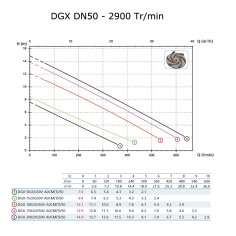
The total head is the vertical height to climb, plus the friction losses in pipes and bends. Choose a pump whose performance curve gives at least the flow you need at that head, and keep a margin. A pipe that is too long or too narrow reduces the real flow noticeably.
A non-return valve on the discharge pipe stops water from flowing back into the tank each time the pump stops. A high-level alarm warns you of a failure or a blockage before the tank overflows.
Small and medium pumps run on single-phase 230 V, like a household socket. High-power pumps (public bodies, industry, lift stations) are available in three-phase 400 V. 12 V and 24 V models also exist for mobile installations.
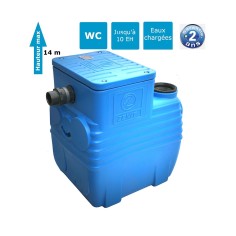
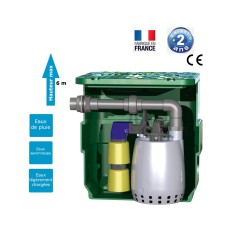
A submersible pump placed at the low point is enough to empty a cellar from time to time. As soon as drainage is permanent (sanitary fittings, kitchen or a basement room), you install a lift station: a sealed tank, one or more pumps, a level control and a non-return valve. Two pumps take turns and keep the service running if one fails.
For the water from toilets, shower and washbasin: a sewage pump, a macerator pump or a lifting micro-station with built-in grinder, depending on the discharge point. Check the free passage and the discharge diameter on the product page. The detail is in the guide Choosing a lift pump.
Our team helps you choose the right equipment for your installation: call +33 3 44 25 91 01 Monday to Friday, 8:30 am to 12:00 pm and 1:00 pm to 4:30 pm (French time), or email contact@pompes-h2o.com. Public bodies can pay by administrative order (mandat administratif), with invoicing through Chorus Pro.